November 20, 2010

Tangential Progress

Wrote this for Zonal NASA 2010 Competition. I was told I won, but there was no certificate given. I like to believe I still did win. :)


TANGENTIAL PROGRESS


What is time?

Time is defined as ‘one-dimensional quantity used to sequence events, to quantify the durations of events and the intervals between them.’ [1]
In modern physics, time is often referred to as the fourth dimension in accordance with the theory of special relativity proposed by Einstein. But how do you classify time as a dimension? Well, in the simplest terms, it is the addition of movement to an object in the three spacial dimensions. But the difference between time and the other dimensions is that time can only be positive. A body cannot be going backwards in time. [2]

How can time and thought be connected?
The word ‘thought’ when coupled with the word ‘process’ automatically adds the dimension of time to the activity of the mind.

How does the term ‘tangent’ connect to thought?
Have you ever wondered how in a span of a few minutes, your mind wanders through a vast variety of subjects, with no recognisable break in flow? That is tangential thought.
At one moment you may be thinking of chocolate ice-cream, and a few minutes later you’re thinking about owning an Aston Martin. How did that happen?
Chocolate ice cream-Italian gelato-gondolas-Titanic-Celine Dion-Canada-C N Tower-acrophobia-bungee jumping-Golden Eye-James Bond-Aston Martin
One thought moving onto another subject which has one point of connection. It is thought that is progressing in tangential planes to each other- Tangential thought.

How can tangential thought be applied?
The importance of idea and invention is proof enough that tangential thought is a necessity. What is progress without the initiative to progress? Where is the initiative to progress without the need to progress? And progress is the transition from past to present and present to future.

Does tangentially progressing thought need a tangentially changing environment?
They say, ‘What we think makes who we are.’ They also say, ‘What surrounds us influences our thought.’ So, if we are to believe that what they say is true, we can conclude that since people are changing, the environment is also changing.

How does the built environment change over time?
Change in terms of the built environment is over a large scale of time. It is change over years. Change due to styles, change due to function and change due to urban expansion. Change is grouped into era time frames: the Prehistoric era to the Neolithic era, Romanesque to Gothic era, the Modernistic to the Post-Modernistic.

Why does the built environment need to change along with the change in time?
Vitruvius emphasizes the relationship of a building not only to its site, but also to the users as they change from past, present to future. Don’t buildings live only as long as they serve a function? And how long is that? 


What is the difference between the paces of changes in thought progress and in the built environment?
There is no doubt about which is moving faster. Is the pace of change in the built environment able to keep up to the pace of thought progress? As the inhabitants change in mindset and lifestyle, is the habitat able to provide satisfactory change?

How can we minimise this difference in pace?
Can we immortalise a structure in such a way that it always serves to provide for the need(s) of its inhabitants?  If this can be achieved, is this tangential progress of the built environment?

Has this kind of immortality of a structure been done before?
Terms like multi-functionality, adaptability, dynamism, polyvalancy, flexibility, etc. have been used to inspire spaces to morph into the changes of its inhabitants.
~Strassgang housing project by architects Riegler and Riewe- ‘“Our intention when we designed was to have a room that would be too large to be an entrance and too small to be a living or bedroom, with a service area in the middle of the apartment, leaving the occupier free to choose how to use the series of rooms lying behind the facade.”’ [3]
~The Hague, designed by Michael Graves- ‘Here, the building to prolong its life, sheds its skin when the urban environment changes. The curtain wall facade almost acquires autonomy; it may be a part of the building but it may also help shape the urban fabric.’ [4]
~The Amsterdam canal- ‘These houses are able to keep accepting changes of function because of their oversized load bearing structure and floor area. In the 17th century, they were large dwelling houses with reception areas and rooms for domestic staff. In the 20th century, these were converted into offices and recently they were again converted into apartment buildings.’ [5]
~The Emotive house, Kas Oosterhuis. This house was designed incorporating virtual reality into the house. Sensors record changes in movement, weather, etc and translate them into particular actions: changing colours, light, textures, alignment of walls, position of windows, etc. [6]
~Army School, Kamaraj Road, Bangalore served as a barrack when it was initially built. Over the years, it functioned as a prison, a hospital and is at present an educational institution.
~XX Office, designed by Jouke Post- This office building is constructed out of dismantable reusable materials with demountable connections to change the frame of the building that can be adapted according to function. [7]

The above examples clearly show that there is a rising need for buildings of this sort: Buildings that morph, buildings that adapt, buildings that are flexible, buildings that are multifunctional and polyvalent.


What is the significance of such Architecture in time?
Time is not static. Neither is it backward. Architecture should withstand the test of time. Only time can tell change. Only change can tell architecture: change that moves from past to present, from present to future. It is a process that takes the good from one and connects it to a creation of something new. This change is a tangential process.


References:

1. "Eric Weisstein's World of Science"
2. ‘Does the Fourth (4th) Dimension of Time Exist’, Gray Pilgrim
3. ‘Has architecture lost its use?’ S. Riegler (excerpt from Time-Based Architecture)
4. ‘Change and the Distribution of Design’, N. John Habraken
5. Excerpt from ‘Time-Based Architecture’
6. & 7. `Towards Time-Based Architecture’ Bernard Leupen  

November 15, 2010

Camp Documentary

We had the most amazing youth camp at Coonoor. 


Thought I'd share our team documentary.


My favourite picture from camp


September 20, 2010

Hyperactive Minds


For all those with hyperactive minds...


  Often the world moves way too fast for you to sit and just think. And even if occasion does call for it or if you do make time for it, it is often that the thoughts that your mind drifts towards are much more exciting and fulfilling than what you intended to 'think' about.

  I'm sure we've all experienced that. We open a book intending to study and over a course of time, find ourselves having not studied a thing but have accomplished something else. Our mind wanders, but not necessarily aimlessly.

  I sit in class prepared to learn, but my mind, unwilling to be leashed, escapes the walls of the ALR. At the end of the class, having paid little or no attention to the working of air conditioners, or the welding of plates, or the characteristics of brutal architecture, or whatever, I have instead planned my weekend schedule, come up with new fonts for my building construction sheet, made a list of study tour destinations and have discussed alternate career options (for just in case). It is totally besides the point of sitting in class, but not exactly a complete waste of my time.

  This semester has taught me that architecture is only fulfilling if it becomes one of those places of refuge for my mind. It cannot be understood by force. I've have tried, in vain to sit and force myself to think. It just doesn't happen. And the result of forced work brings satisfaction only because it’s done. I'm speaking for myself here, because if you can make your mind think when you want it too, you are unlike me and I envy you greatly.

  For me, coming up with a concept for design is like asking me for the lyrics of a song. It’s there somewhere inside my head, refusing to budge from that corner out of reach. But it most definitely will, when I least expect it to, on the bus, in the shower or in estimation class and suddenly I'll find myself singing the whole song, beginning to end.

  It’s not an excuse. No one else will understand. It’s a disability that I've learned to deal with. I'm learning to make design my destination of wandering thought. It’s not that hard, once you put your mind to it. But that is just not possible consciously. Subconsciously, you tend to think of things that are of some interest or importance to you. Make design that subconscious thought. I don’t know of any way to do that. But I do know that when it does happen, it comes with a multiplied force. Suddenly, out of the blue, I have a concept that I absolutely love, a design that appeals to me and that immense feeling of satisfaction that I can move forward and achieve, especially because I've been able to move away from almost giving up.

  What I can say to you, who understands what I've talked about. Free your mind. Let it wander. Let it uncover those ideas which you know are hiding somewhere in your mind. Don’t lose that creative spark that you have by holding too tightly to your minds reins. Be a daydreamer. Be a mind traveller. Just map out your route.

December 31, 2009

This Year...

This year...

365 days, 52 weeks, 12 months,... it all goes so fast. But we tend to say that at the end of every year. It goes the same for this year, but the difference here is that from the blur of the year, there have been so so many things that I've learnt.

December 06, 2008

Blood Diamond Review

Wrote this for the MSRIT Movie Club.


BLOOD DIAMOND (2006)
Director:  Edward Zwick

It is the gripping story of the life threatening quest for a rare diamond. Set in Sierra Leone in the 1990’s during the civil war, Blood Diamond shares the story of the lives of two very different men, Danny Archer (Leonardo DiCaprio) and Solomon Vandy (Djimon Hounsou) brought together by one valuable diamond. It was found and then hidden by Vandy when he was separated from his family and forced to work in the RUF mines. But its existence did not remain a secret. For diamond smuggler Archer, the diamond’s value in the black market would contribute financial help for the RUF rebels’ artillery, giving him his ticket to leave the country. For Vandy it meant freedom and being reunited with his family.

The issue portrayed in the movie, along with the illegal trade of diamonds, is the heartless recruit of child soldiers by the rebels. Among the child soldiers is the Dia Vandy (Kagiso Kuypers), the son of Solomon, so forcefully ingrained with the brutal idealisms of the RUF rebels that family love is initially overpowered by the RUF brainwashing when he is reunited with his father.

What is a good movie without a little romance, even if it is as faint as it is in this movie? The story brings in another character, Maddy Bowen (Jennifer Connelly), and American journalist visiting Africa to research and stop illegal diamond trade. She gets caught in this diamond quest and uses her sources to help Archer and Vandy. The short time spent with Archer forms a deeper connection between. Although no love is expressed verbally both feel a need for the other.

The movie very cleverly ties the two extremes of the story; love for money and love for family with the right amount of suspense, violence, emotion, pain, joy and adventure to keep one entertained throughout the movie. The performance of the risk-it-all fatherly love of the character played by Hounsou and the selfish determined character played by DiCaprio is certainly worth a standing ovation. I also like the contrasts seen between the rural settings in Africa to the highfaluting settings of London.

When analysing the content of the movie, it is apparent that the main theme of the movie is adventure and not the social issues concerned. Although the issues are brought out, I feel that the magnitude of the harshness of the war and extent of the bribery are not given justice in the movie.

About the ending of the movie, it provides a happy ending for viewers to feel good about as well as a sad side, which shows that there is not all happiness in war. Although the phone call to Maddy made by Archer before his death on the top of a mountain seemed a little clichéd, the abrupt end to a potential romance added an interesting twist to the movie.

All in all, it is a movie I would highly recommend, for its praises outnumber its flaws by far.

October 19, 2008

July 4, 2008


Day 2 at the LFA.

Along the Thames


With some time to spare before the first event on my list for the day, I spent the morning at Westminster. I marvelled at the architecture of the House of Parliament and Big Ben and then walked down to the abbey. I first went into a small little church next to Westmister abbey and although photography was not allowed, I managed to get a couple of pictures of the interiors with the camera on my lap!

August 27, 2008

July 3, 2008

I was really looking forward to attending the London Festival of Architecture 2008-a month long festival packed with hundreds of different events around the city ranging from exhibitions, building tours, cycling tours, open studios, etc. I stumbled upon the site while looking at a site about free things to do in London.


I traveled for the first time by myself in the underground. It was a lot of fun and as long as I had my tube map and London street guide I would be fine. (felt like I was walking on the Monopoly board!)


London- the city and the parks

August 25, 2008

June, 2008


June 27


The long awaited for trip. Just one week after wretched exams and submissions and all my bags are packed and I'm ready to go for a 5 week holiday to England.


The journey was not exactly memorable. I had travelled alone before, but this was minus the benefits of unaccompanied travel. I watched 3 movies back-to-back; The Kite Runner, The other Boleyn Girl and P.S, I Love You and landed at Terminal 5 through grey clouds and cold rain- typical English weather.


What I remember from the next few days:


~Sleeping from 3 on Saturday afternoon till 7 the next morning curled up in the duvet of the top bunk.
~Strawberry picking on Sunday morning- Stuffed myself with strawberries, raspberries and tayberries.
~Being united with my laptop.
~Jumping on the trampoline!
~Eloise locking herself in the house the day I was babysitting her. I had to climb over the side gate (not that easy!) to get to the back door which, thankfully was not locked. Surprisingly, I was asked to look after all 3 girls by myself on several occasions after that incident!
~Jason choking with laughter, unable to breathe at Jo and my first attempts at the dance. My spastic hands!
~Losing in MAM- sorry girls. We never lose, do we? I completely take the blame-
I was blind:
Proof 1-
(thinking to myself): hey cool, Im out of yellow, and I have so many blues... maybe I should take the bid. Only later did I realise that this set didn't have yellow and had purple (It looked BLUE-ish) instead. This confused me throughout the ENTIRE game.
Proof 2-
I didn't realise that I had the Tiger till the second last hand. I'm telling you, it looked like the bull and where on the card does it say 'Tiger' in capital letters?
I also suffered temporary Alzheimer's and lost count of all cards. Where did 30 trumps go?
~Eating a mushroom Blintz. Very yummy!
~Punching 150 gold puzzle pieces.
~HAY FEVER!- finishing all the tissues in everybody's house!

May 12, 2008

Stationary and Stationery

Just the difference of one letter & yet these two words occupy two different extremes in the vast world of Architecture.

STATIONARY-
unable to move, being fixed.

Being stationary in architectural terms refers to being mentally stationary, which causes the minds to freeze.

It is the frustration, when someone, expecting to be blown over by your creative mind, thrusts a seemingly scopeful proposition or even a simple question, but your mind is stationary and all that you can see in your mind is a crisp white sheet. This is a state of being mentally stationary.

It also refers to a more serious disease that takes more than time to cure. The disease that makes your mind so solidly fixed onto one set of ideas that in order to create something new and unique, you would have to jump over the hurdle of normalcy.

But it is the ease by which you overcome being stationary that defines you as an architect.

STATIONERY- writing material.

One change in the word and you are plunged into the molten core of Architecture!

The butter sheets, pencils, cartridge sheets, Rotring pens, paint, set squares, stumping powder… The list is endless!

Even though AutoCAD, 3Dmax and the rest of their software siblings bask in the limelight of being the backbones of Architecture, it is the pencils shavings, crusty paint palates, and the wad of crumpled butter sheets with undecipherable scribbles, without which ideas would remain ideas.

Can you keep track of the time and money spent at the stationery shop? Have you ever wished that someone would give you a bundle of handmade sheets as a birthday present? Have you ever thought about how many erasers you use in a year? The answers to these questions will prove how important stationery is to you.

So how do I bring together two outwardly similar words- one a mental disease and the other a primary necessity? I’ll leave that to you. But, have you ever imagined how stationary you would be without your stationery? :)


(wrote for Ramaiah archi magazine)


January 25, 2008

1st Semester


Ist Semester (September- December)


This is the first model we had to make for design workshop class. The theme was lines and intersecting planes composed in a space of a 1" cube. It was a 3 hour class and at the end of it, I had a few scribbles on my butter sheet and had managed to bend a bit of wire into ONE petal. Yup, that’s all I did in 3 hours (I spent most of that time laughing. Shuwana's "madness" had already begun to have ill-effects on me or vice-versa or was it just madness resonating between us, we shall never know) BUT, I had an idea and could imagine every detail of it in my mind. It was going to be an abstract model of a hibiscus or a gul-mohar flower. Thankfully we had until next class to have it finished (there were even people submitting it in December before final submissions!). Working on it was a nightmare!!! The frustration of winding that shoe-lace-like material around and round and round would have caused me to fling the whole thing out of the window had not this lovely course allowed me to do work in front of the TV! That was a nice movie... oh look, I'm almost done!


Pottery Workshop- This was lots of fun. A local potter came in along with his wheel. It was a challenge trying to explain to him what I wanted to do (shame on me for not knowing the local language!) I made most of it on the wheel, but the hole, I had to do with my fingers.... On the right are a few of the other's pots and Maria's head (or more precisely- the head that Maria made. lol) after we varnished them.


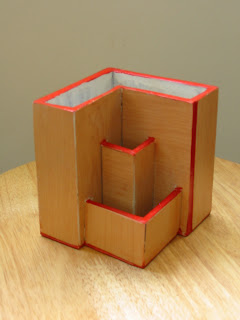
Carpentry Workshop: I missed the actual workshop at college, but the following week my room became a temporary carpentry workshop! I was initially sawing with a hack saw blade (yes just the blade... don't know where the handle disappeared to!). Then, noticing that my fingers were turning blue and that I would probably not be able to lift my arm the next morning, took out THE ELECTRIC HAND SAW. It was freaking heavy, and for fear of losing a finger or an arm or even a leg for all I know, happily accepted the help of my Dad. I love laminate; it covers oh so many mistakes. And the red paint adds a very delightful touch! ;)


I don't know why I took a picture of my colour chart. This was the day before submissions and I had wasted so much time doing this simply because it was fun! Especially like the blue swirly thing.


I suddenly realised that I was one model short and so managed to make this in about 15 minutes! Supposed to be RHYTHM and I managed to include rhythm in colour, shape, size, texture and direction. (looks like something I could have made when I was 6, nevertheless I still like it!)


I SO wish I had taken more pictures! Then again, there's always next semester (and another 8 more after that).
p.s. Lots of fun pictures were taken from our Building Construction workshop in the rain... but they are all over the place i.e. with lots of people and I only have a few that I downloaded (because somebody forgot to take their camera... tch tch tch).